Facial Volume
Loss
Hollow cheeks and temples, and a face that looks deflated.
With Dr. Juliya Fisher and Dr. Shereene Idriss.

In Brief
Facial volume loss is the hollowing and flattening that comes as the bone beneath the face thins and its fat pads, muscle and collagen shrink, with age or weight loss. We restore the support that was lost, using hyaluronic acid filler for precise structure, Sculptra and Radiesse to rebuild your own collagen, and your own fat for broader, lasting volume.
Diagnosis First
Dr. Idriss compares the face to a couch. There is the wooden frame, the cushions on it, and the fabric over both.
- Bone, the frame. Bone density thins with age. The cheekbones narrow, the jawline recedes and the area around the eyes hollows, leaving less to hold the face up.
- Fat and muscle, the cushions. The fat pads in the face shrink and drop and the muscles thin, so the temples hollow and the sides of the cheeks flatten.
- Skin, the fabric. Sun, time and life loosen the skin. Over a frame and cushions that have shrunk, it can look looser than it is. Put the cushion back, and the fabric looks taut again.
All three change slowly from your late twenties on. Weight loss, including on a GLP-1 medication such as Ozempic, doesn’t cause this, but it shows it sooner. Weight loss “is simply revealing the natural aging process happening underneath the surface of your skin,” as Dr. Idriss says. Some faces mostly hollow, which she calls sinking; others mostly droop, which she calls sagging. Most do some of both.
Before anything is placed, your dermatologist reads whether your face has hollowed, dropped or both. The order of treatment follows from that.
What We’d Skip
A deflated face tempts people to fill exactly where it looks empty. That is rarely the answer.
Don’t expect a cream to put volume back
Volume loss is structural. “No serum, no cream, no magic over-the-counter skincare will ever restore the volume you lose,” says Dr. Idriss. Skincare looks after the skin, but it can’t rebuild bone or fat.
Don’t fill the hollow you see
Filling the exact spot that bothers you is how faces end up puffy. Support goes back where it was lost, often away from the hollow itself, within what your bone structure can hold.
Don’t expect filler to lift a sagging face
Filler is a gel, and it can’t lift a face, though placed well it creates the illusion of lift. If your face sags more than it hollows, skin tightening is the better place to start.
Don’t only tighten a face that has hollowed
Tightening a face that has lost volume can make it look smaller. Volume comes first, and tightening is layered in after.
Don’t rebuild a face that is still changing
If you are losing weight, slow and steady is kinder to your face. Volume can be restored a little at a time along the way. A big step such as a facelift waits until your weight and your face have settled.
How Is Facial Volume Loss Treated?
Where the volume went, how much is gone and how well your skin is holding up all shape the plan.
- Volume lost in specific places, such as the cheekbones, temples, jawline or chin. Dermal Fillers give precise structure right away and can be dissolved if ever needed. Placed with care, hyaluronic acid filler creates definition and the illusion of lift. It never lifts sagging skin.
- Broad volume loss with thinning skin, usually from the forties on. Sculptra & Radiesse prompt your skin to build its own collagen over months. Dr. Idriss likes Sculptra to build an under padding for a face that has hollowed, then light filler to maintain it. Neither is a first time cosmetic treatment.
- Deeper volume loss, including after weight loss. Regenerative Fat Transfer moves a small amount of your own fat in one visit under local anesthesia, for a lasting result. Because the fat that settles stays, it is done slowly and conservatively.
- Early sagging along the jaw and cheeks as well as volume loss. PDO Threads lift in a chosen direction and build collagen around them, but they do not replace volume, so they work alongside the treatments above, never instead of them.
If your face sags more than it hollows, our skin tightening page compares Ultherapy, Morpheus8 and SecretRF. For hollow under eyes, see under eyes and dark circles.
The Treatments
Three treatments restore volume, and one lifts alongside them.
- Reversible: can be dissolved
 Dermal FillersHyaluronic acid gel for precise structure, placed in small amounts where support was lost
 Sculptra & RadiesseCollagen building injectables for broad volume loss and thinning skin
 Regenerative Fat TransferYour own fat, moved in one visit, for deeper and lasting volume
 PDO ThreadsDissolvable threads that lift early sagging; they add no volume
Side by Side
Filler, Sculptra and Radiesse, and fat transfer each restore volume in a different way, and threads lift instead. Your doctor often combines them.
| Treatment | How it works | Suited to | Downtime | Sessions | Results |
|---|---|---|---|---|---|
| Dermal FillersHyaluronic acid fillers and Skinvive | Hyaluronic acid gel placed in small amounts at precise depths where structure was lost; it can be dissolved | Volume lost in specific places, such as the cheekbones, temples, jawline and chin, and fine adjustments | Little; possible swelling or bruising | Built gradually; lips about 8 weeks apart | Right away |
| Sculptra & RadiesseCollagen building biostimulators | Sculptra (poly-L-lactic acid) or Radiesse (calcium hydroxylapatite in a gel) prompts your skin to build its own collagen; it cannot be dissolved like hyaluronic acid | Broad volume loss with thinning skin, such as hollow temples and cheeks; lasts longer than hyaluronic acid filler | Little; possible swelling or bruising | Sculptra: a series; Radiesse: as your plan needs | Radiesse right away; Sculptra over months |
| Regenerative Fat TransferYour own fat, moved in one visit under local anesthesia | A small amount of your own fat, taken under local anesthesia, prepared within the hour and placed the same visit; never stored | Deeper volume loss, including after weight loss, when a lasting result from your own tissue appeals | Days for the face; donor area sore 1 to 2 weeks | Not always one; no more than every 4 to 5 years | Settles over months; not all of the fat stays |
| PDO ThreadsDissolvable PDO threads | Dissolvable PDO threads placed beneath the skin hold it in a chosen direction and build firmer collagen around them | Early sagging along the jaw and cheeks alongside volume loss; they lift rather than add volume | A few days; possible swelling, bruising or tenderness | Usually one; not repeated every visit | Right away, settling over about 2 weeks |
“Sculptra and Radiesse work by building your own collagen, and they cannot be dissolved the way hyaluronic acid filler can. So I place them carefully, and only where the face has truly lost support.”
In Their Words

“
Love Dr. Idriss and everyone on her team. I have been getting filler done for the past few years (39 y/o) and it’s always perfect/exactly what is needed to look great but not obvious – worth every penny!! She is so talented but also so personable – my appts have never felt rushed, no long waits, no pressure to get more treatments etc. …
Caroline G.
“
I highly recommend Dr. Fisher. I followed her from her previous practice and I continue to be happy with my results. I’ve gotten fillers and laser. Whenever I’ve wanted to do more, she was always honest with me. If I didn’t need it, I could count on her to tell me
Lillian J.
“
I would recommend Dr Idriss a thousand times over and over. She is extremely knowledgeable, knows what will work and what won’t and will always give you an honest recommendations. You will never feel pushed into moving forward with any injections or procedures.
Hiva F.
“
Dr. Fisher is amazing! She answered all of my questions and never pushed me onto anything. She cares about her patients. Will definitely come to her again if I need an opinion on anything relating to hair or skin.
Zubaida M.
Bryant Park, New York
Your Dermatologists

Founder
Dr. Shereene Idriss
Candid advice, subtle results.
Board-certified, Practicing since 2013
Dermatologic Surgeon
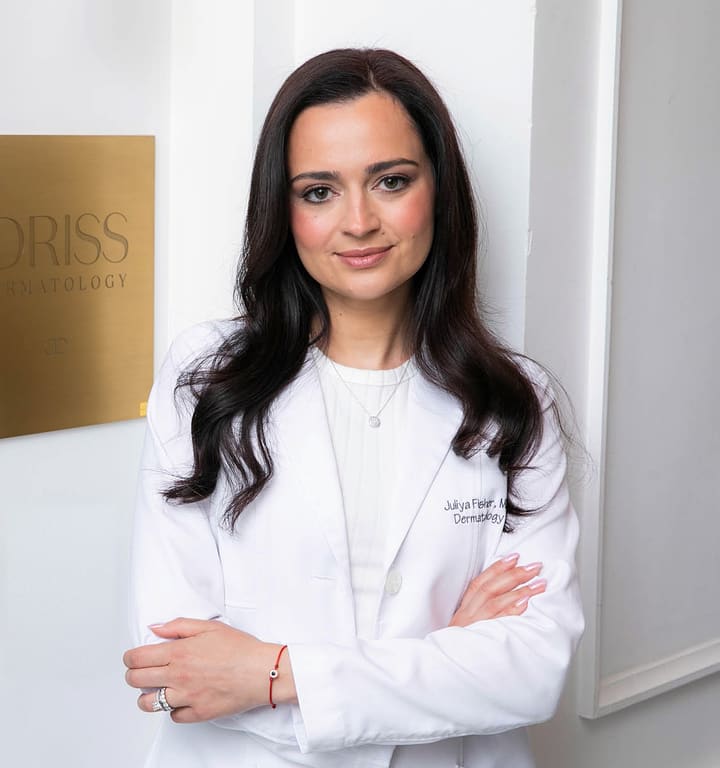
Dr. Juliya Fisher
Trained to work in millimeters.
Double Board-certified, Columbia Mohs fellowship
Both doctors share one philosophy, so either is a good place to start. Book online with Dr. Fisher, or call (212) 612-1520 for Dr. Idriss.